
Loading
Procedure guide · Face
 Neck Liposuction
Neck liposuction removes unwanted fat from beneath the chin and along the upper neck to create a cleaner jawline and more defined chin-to-neck contour. It works best in people who have localized fat but still have reasonably firm, elastic skin. The procedure is usually performed through very small incisions, often under local anaesthesia, and most patients go home the same day. Bruising and swelling improve over the first few weeks, while the jawline usually becomes more defined over 1–3 months.
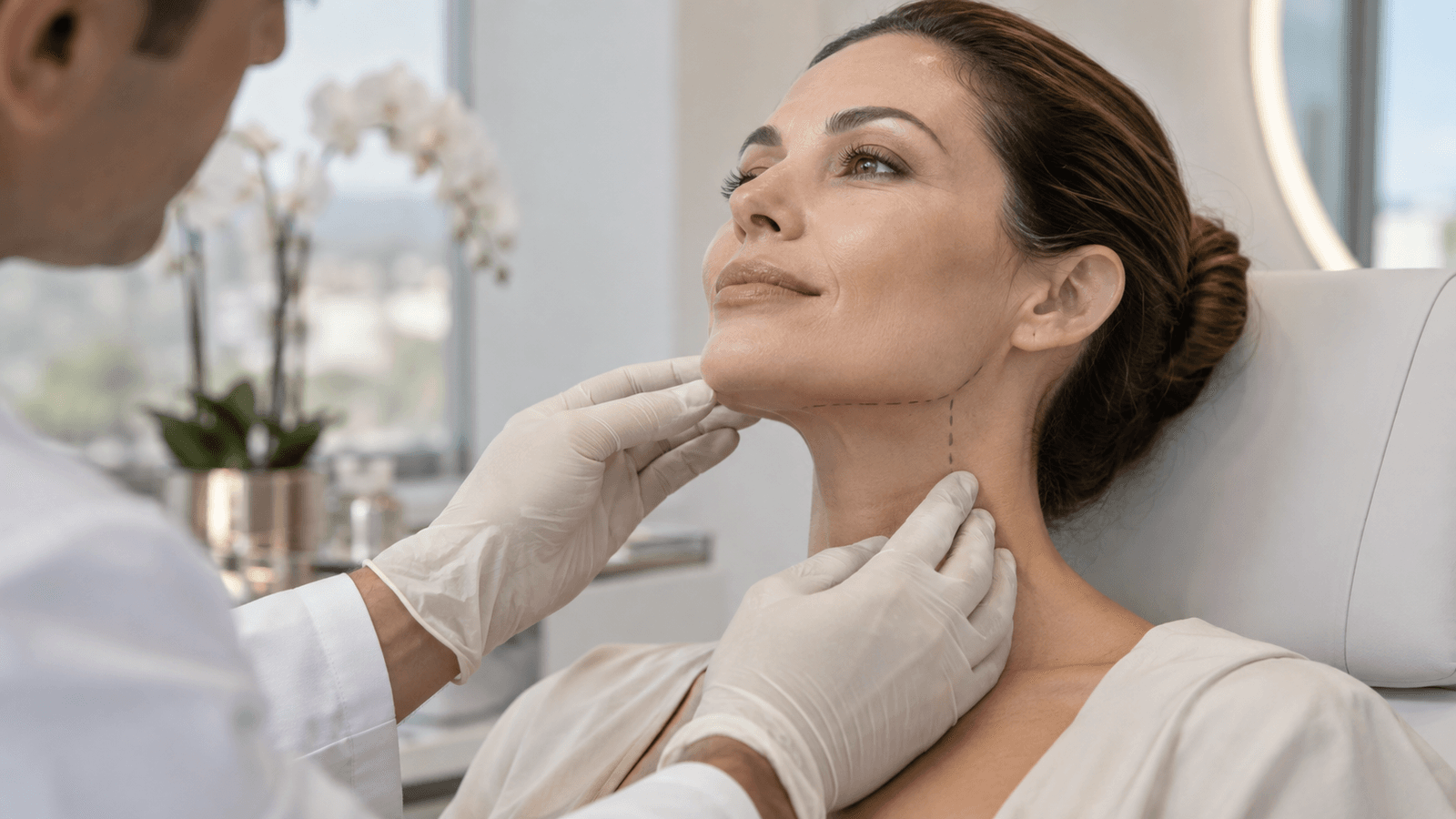
Neck liposuction is a cosmetic operation that removes unwanted fat from beneath the chin and upper neck.
You may also hear it called:
The word submental simply means the area beneath the chin.
During the procedure, the surgeon makes one or more very small openings in discreet locations, usually beneath the chin or near the ears. A thin tube called a cannula is passed beneath the skin and used to gently remove unwanted fat.
The aim is not to make the neck unnaturally thin. The aim is to create a smoother transition from the chin to the neck and improve the definition of the jawline.
Neck liposuction can help when the main problem is fat beneath the skin.
It may improve:
ASPS facial plastic surgeons describe submental fullness, or a double chin, as a common reason people seek facial contouring.
One ASPS surgeon, Lara Devgan, MD, explains:
“Submental fullness … is one of the most common concerns among patients seeking facial contouring.”
This is one of the most important parts of the page.
Neck liposuction removes fat.
It does not directly remove:
If a patient already has significant loose skin, removing the fat underneath it can sometimes make the loose skin more obvious.
ASPS notes that patients with poor skin elasticity or more advanced laxity may need a surgical neck lift instead.
That is why good patient selection is more important than simply seeing a “double chin.”
Best for:
The operation uses tiny incisions and removes fat with a thin suction tube.
Better suited to:
A neck lift is a more extensive surgery and may treat the skin, fat and underlying muscle together.
Some patients have both excess fat and loose skin.
In those cases, liposuction may be combined with a neck lift so the surgeon can remove unwanted fat and tighten the loose tissues at the same operation.
Some skin contraction usually occurs as swelling resolves and the tissues settle.
However, how well the skin shrinks depends on:
This is why two people with the same amount of neck fat can have very different results.
Patients with firm, elastic skin are generally better liposuction candidates than patients with thin or significantly loose skin.
Patients should be cautious of promises that neck liposuction will automatically tighten large amounts of loose skin.
Liposuction permanently removes the fat cells that are suctioned away.
However, it does not prevent future weight gain.
Remaining fat cells can become larger if a person gains significant weight, so maintaining a stable weight helps preserve the result. ASPS notes that improvements from liposuction can be maintained when patients continue healthy diet and fitness habits.
Surgeons look for these points at the consultation.
Neck liposuction usually works best when the problem is fat rather than loose skin.
Reasons a good surgeon will ask you to wait or choose something else.
Neck liposuction may not be the right procedure when the problem is not mainly fat.
Ask your surgeon which technique they recommend for you and why.
A thin tube is passed through very small incisions beneath the chin or around the neck. The surgeon carefully moves the tube through the fatty layer and removes unwanted fat using suction.
The surgeon uses a smaller liposuction tube to make more delicate adjustments around the chin and jawline.
The liposuction tube gently vibrates to help loosen fat before it is suctioned away.
Ultrasound energy is used to help loosen fat before it is removed through liposuction.
Step by step, from arrival to discharge.
The surgeon examines the chin, jawline, skin quality and fat distribution. The treatment area is marked while the patient is upright so the surgeon can see where fullness is actually located.
Standalone neck liposuction is often performed with local anaesthesia. Sedation or general anaesthesia can also be used when appropriate or when the procedure is combined with other surgery.
Very small openings are made beneath the chin or in discreet locations near the ears. ASPS surgeons describe access points as small as approximately 3 mm in selected techniques.
A thin tube called a cannula is passed under the skin. The surgeon moves it carefully through the fatty layer and removes a controlled amount of fat using suction.
The surgeon checks both sides of the neck and gradually blends the treated area so that the jawline looks smooth rather than hollow or uneven.
A supportive chin or neck garment may be placed after surgery to limit swelling and support the tissues while they heal.
Frequencies follow published guidance; your personal risk depends on your health and the surgeon.
Swelling and bruising are normal after neck liposuction. They usually improve gradually over the first few weeks. Most swelling is substantially better by around 4–6 weeks.
SourceThe neck can temporarily feel firm or uneven while swelling settles. Less commonly, too much or uneven fat removal can leave visible hollows, lumps or asymmetry. ASPS lists contour irregularities among recognized liposuction risks.
SourceA small pocket of clear fluid can collect beneath the skin. Some resolve on their own, while others may need to be drained. Seroma was one of the more frequently reported minor events in the 2026 systematic review.
SourceA nerve controlling movement near the lower lip runs through the jaw and neck region. Temporary weakness has been reported after submental liposuction, while serious lasting injury appears uncommon.
SourceAny surgical incision can become infected. Increasing redness, worsening pain, fever or drainage should be reported promptly. Infection is an established but uncommon liposuction risk.
SourceBlood can occasionally collect under the skin and create swelling or pressure. Large or rapidly increasing swelling requires prompt medical assessment.
SourceIf the skin does not shrink well after the fat is removed, the neck can look loose or wrinkled. This is why liposuction alone is less suitable for patients who already have significant loose skin.
SourceThe treated skin may feel numb, tingly or different for a period after surgery. Most sensory changes improve as swelling settles, although persistent changes are possible.
SourceDays 0–3
The neck feels swollen, tight and tender. Bruising may begin to appear. A chin strap or compression garment may be recommended.
Days 4–7
Most patients can move around normally and many return to light work during this period, depending on swelling and the type of job. The jawline may already look slimmer, although swelling still hides the final result. ASPS surgeons report that visible improvement can begin during the first week.
Weeks 2–3
Bruising and tenderness usually improve significantly. Cleveland Clinic reports that swelling and bruising from double-chin surgery commonly last around 2 weeks, although individual recovery varies.
Weeks 4–6
Weeks 4–6 — Jawline becomes clearer Most swelling has now reduced, and the shape beneath the chin becomes easier to see. ASPS surgeons describe 4–6 weeks as a point when the majority of swelling has usually subsided.
Around 3 Months
The neck generally looks more natural and settled. ASPS experts describe approximately 3 months as the stage when the most refined result becomes apparent after uncomplicated submental liposuction.
Neck liposuction can create a slimmer profile and sharper transition between the chin, jaw and neck when excess fat is the main problem.
Patients often notice a difference quickly, but the initial result is partly hidden by swelling.
ASPS surgeons report that contour improvement may be noticeable in the first week, becomes clearer at around 4–6 weeks, and is more refined by approximately 3 months.
The fat cells that are removed do not grow back.
However, remaining fat cells can enlarge with future weight gain, and skin continues to age normally. Maintaining a reasonably stable weight can therefore help preserve the result.
The quality of the result depends heavily on starting anatomy.
A patient with:
can get a much cleaner result from liposuction alone than a patient with significant loose skin or a weak underlying jaw.
That is why neck liposuction should be presented as contouring surgery, not simply “fat removal.”
Why quotes for the same procedure differ, so you can compare packages fairly.
Options to weigh before deciding, surgical and non-surgical.
A neck lift is usually more appropriate when loose skin or platysma muscle laxity is more important than fat. It can remove excess skin and tighten deeper neck tissues that liposuction cannot correct.
A small or recessed chin can make the area beneath the chin appear fuller. In selected patients, improving chin projection can strengthen the jawline and may be combined with liposuction.
Some patients with a small amount of submental fat may consider nonsurgical treatment. These options generally require different treatment schedules and do not remove loose skin. Neck liposuction usually removes the fat in a single surgical session.
A double chin is a normal anatomical variation and does not require treatment. Surgery only makes sense when the patient personally wants contour improvement and understands the limitations and risks.
Ask the same questions at every consultation so you can compare answers.
Photographs are often the first thing a researching patient looks at, and they are easy to misread. A set of images can be perfectly genuine and still tell you very little about what to expect, so it helps to know what to check.
Look at the starting anatomy, not only the result. The most useful comparison is with a patient whose neck resembles yours before surgery: similar age, similar skin quality, similar amount of fat, and a similar chin and jaw shape. A striking change in a young person with firm skin says little about how the operation behaves in an older neck with softer skin.
Check that the conditions match. Honest comparisons use the same camera distance, lighting, head position and expression. Lifting the chin, tilting the head back or tensing the neck can make an "after" image look sharper than a relaxed one. Clenching the jaw in one image and not the other is a common source of apparent difference.
Note when the "after" picture was taken. Swelling hides the final shape for weeks, and the refined contour appears later still. An image taken a few days after surgery shows swelling, not the result, while one taken many months later also reflects any change in weight or ageing. Ask how long after surgery each photograph was taken.
Ask what else was done. A visible improvement in the jawline may owe something to chin augmentation, a neck lift or skin treatment performed at the same time. If the caption does not say, ask.
Be cautious about editing and selection. Filters, retouching and heavy make-up have no place in clinical photographs. It is also reasonable to ask whether the images are a representative selection or the best cases. A surgeon who is comfortable showing a typical result, including a modest one, is giving you more reliable information than a gallery of only dramatic changes.
Look for the less flattering views. Side and three-quarter views show hollows, irregularities and residual fullness far better than a straight-on photograph. A good set includes several angles.
Remember whose photographs these are. Images should belong to the surgeon or clinic you are considering and show patients who gave consent. Pictures borrowed from elsewhere, or from a different surgeon, tell you nothing about the work you would receive.
Consider skin tone and scarring. Small incisions are hard to see in most photographs, so images say little about how marks heal in your skin. If you tend to form dark or raised scars, ask the surgeon to explain where the access points would be and to show healed examples on similar skin.
Finally, treat photographs as one piece of evidence rather than a prediction. Individual healing, skin behaviour and anatomy differ, and no image can show how your own neck will respond. Surgeons usually consider photographs alongside an examination, and a frank discussion of what is realistic for you matters more than any single picture.
Neck liposuction removes unwanted fat from beneath the chin and upper neck using a thin suction tube inserted through very small incisions. It is designed to create a slimmer neck and clearer jawline rather than remove loose skin.
The terms are often used interchangeably. Chin or submental liposuction usually refers specifically to the area directly beneath the chin, while neck liposuction can include a wider area extending toward the jawline and upper neck.
Good candidates usually have localized neck fat, reasonably elastic skin, good general health and little significant neck-muscle banding. Patients with a large amount of loose skin may get a better result from a neck lift.
It may allow some natural skin contraction, particularly in younger patients with good skin elasticity, but it does not remove excess skin. Significant loose or hanging skin usually requires a different procedure such as a neck lift.
ISAPS lists neck liposuction as typically taking approximately 30 minutes to 2 hours. A small standalone procedure is usually toward the shorter end, while combined or more extensive surgery can take longer.
Not always. Standalone submental liposuction can often be performed with local anaesthesia. IV sedation or general anaesthesia may be used for patient comfort or when other procedures are performed at the same time.
Many patients return to light work within several days to one week. Bruising and swelling usually continue improving over the following weeks, with most swelling substantially reduced by around 4–6 weeks.
Early improvement can be visible during the first week, but swelling hides the true contour. ASPS surgeons report that the jawline becomes clearer by approximately 4–6 weeks, with a more refined result around 3 months.
The fat cells removed by liposuction are permanently removed. However, remaining fat cells can enlarge if you gain significant weight. Maintaining a stable weight helps protect the result.
It can make existing skin laxity more noticeable if too much fat is removed or if the skin does not contract well. That is why skin elasticity should be assessed before surgery.
Possible problems include bruising, swelling, temporary numbness, fluid collection, uneven contours, infection, loose skin and, less commonly, nerve injury or significant bleeding. A 2026 systematic review found that most reported adverse events were minor, but also emphasized that high-quality complication data remain limited.
Yes, but the access points are usually very small and placed in discreet areas such as beneath the chin or near the ears. ASPS surgeons describe incisions of around 3 mm in some submental liposuction techniques.
If the main problem is fat and the skin remains firm, liposuction may be enough. If loose skin, muscle bands or more advanced neck ageing are the main concerns, a neck lift may provide a more complete result.
Surgeons usually advise sleeping on your back with your head raised on pillows or in a reclined position for the early part of recovery. Elevation helps limit swelling, and sleeping on your back avoids pressing on the treated area or shifting the chin garment.
Your surgeon will say how long to keep this up and when you can return to your usual position. Many people find that propping up with extra pillows for the first days is enough. Following the specific instructions you are given matters more than any general rule, because they depend on the technique used and whether other procedures were performed.
Avoid sleeping with your chin pressed down toward your chest, and ask whether a soft travel-style pillow would help keep the head steady. If you wake with sharply increasing swelling or pain on one side, contact the surgical team rather than waiting for the next review.
Timing depends on your surgeon's assessment rather than a fixed number of days. Many surgeons want to review the neck once early swelling and bruising have been checked, and to be sure there is no fluid or blood collection, before the patient travels.
Long journeys also add a small risk of blood clots after any surgery, so staying hydrated, walking regularly and following advice on compression stockings and medication is sensible. Air-pressure changes are not generally a concern for the neck itself, but a tight chin garment, swelling and tiredness can make travel uncomfortable.
Ask in advance how long you are expected to stay near the surgeon, who will examine you before you leave, and what to do if a problem appears once you are home.
It should not. The fat removed lies in a layer beneath the skin, above the muscles and the structures used for speaking and swallowing, and neither the voice box nor the throat is treated.
Some people notice a tight, stiff or tender feeling in the neck for a while, and swelling can make swallowing or turning the head feel slightly awkward in the first days. A hoarse voice can follow a breathing tube if general anaesthesia is used, and this usually passes quickly.
Difficulty breathing, increasing difficulty swallowing or rapidly growing swelling are not expected and need urgent medical attention. Mention any voice or swallowing concerns at your consultation so that they can be recorded beforehand. People who sing, speak professionally or have had previous neck surgery or thyroid problems should say so, as this helps the surgeon plan and the anaesthetist prepare.
Yes. It is sometimes performed together with a neck lift, chin augmentation, a facelift or other facial surgery, depending on what the surgeon finds on examination. Combining procedures can mean one recovery period rather than several.
The trade-offs are a longer operation, more swelling and bruising, and a greater need for general anaesthesia. Surgeons usually weigh these against the patient's health, the number of areas treated and the overall plan, and some will recommend staging procedures instead.
It is worth asking why each procedure is being added, what it contributes to the result, and how the plan would change if you chose to have only one part. Extra procedures should be driven by your anatomy, not by convenience.
Revision is sometimes possible, but surgeons generally wait until swelling has settled and the result is stable, often several months, before judging whether anything needs correcting. Early irregularities frequently improve without further treatment.
Whether a second procedure helps depends on the cause. A small area of residual fat may be refined, while hollows, loose skin or muscle bands usually need a different approach. Scar tissue from the first operation can also make a second one more demanding, so revision is often more technically difficult than the original surgery.
If you are unhappy with a result, return to your original surgeon first where possible, and consider a second opinion from an independent specialist who can assess the neck without any commitment to the earlier work.
International Society of Aesthetic Plastic SurgeryProfessional society
American Society of Plastic Surgeons2025Professional society
American Society of Plastic SurgeonsProfessional society
American Society of Plastic SurgeonsProfessional society
Journal of Oral and Maxillofacial Surgery2026Peer-reviewed
Aesthetic Surgery Journal2024Peer-reviewed
Johns Hopkins Medicine2026Clinical guideline
Cleveland Clinic2026Clinical guideline
Consultation request
Tell us the procedure and destination you are considering. We forward your request to the verified clinic you select.