
Loading
Procedure guide · Face
 Septorhinoplasty
 combines septoplasty, which straightens the internal nasal septum, with rhinoplasty, which reshapes or supports the external nose. It can improve nasal obstruction while also correcting a crooked, asymmetric or structurally deformed nose. Surgery is usually performed under general anaesthesia and commonly takes about 2–3 hours. Patients often need around 2 weeks off work, while breathing may take several months to settle and the final external nasal contour can continue refining for up to 1 year.
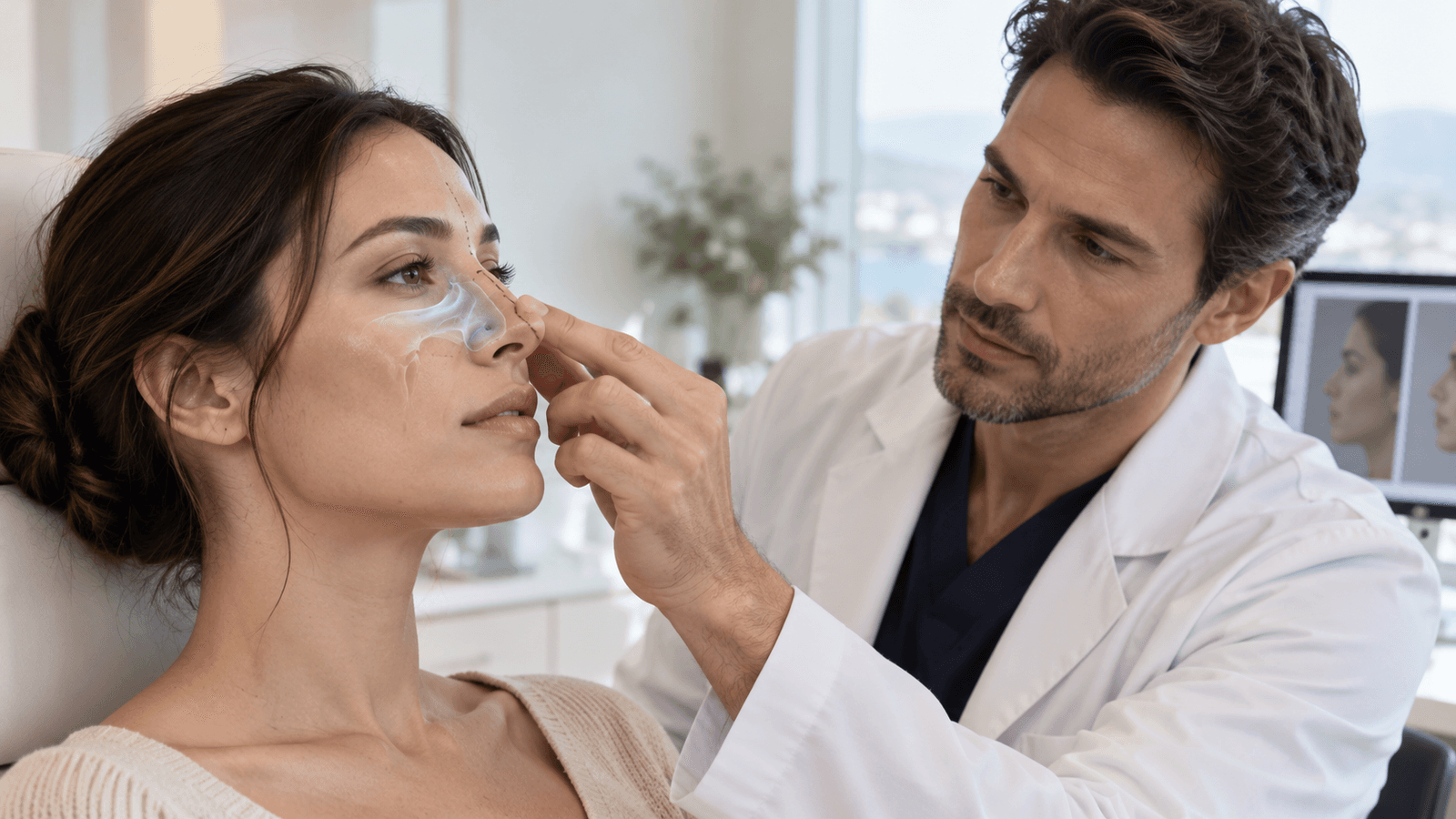
Septorhinoplasty is an operation that combines septoplasty and rhinoplasty during the same surgical procedure.
The septum is the wall of cartilage and bone separating the left and right nasal passages. When it is significantly bent, or deviated, it can reduce airflow through one or both sides of the nose.
Septoplasty straightens or reconstructs this internal structure.
Rhinoplasty changes or supports the external nasal framework—the bones, cartilage, bridge, tip or nostrils.
Cambridge University Hospitals describes the operation in two parts: septoplasty straightens the septum, while rhinoplasty changes the shape of the nose.
An ASPS facial plastic surgeon, Omar Hussain, MD, FACS, summarizes the relationship between the operations:
“These procedures can overlap when the external appearance is affected by a crooked septum.”
That distinction is important. Not every patient with a deviated septum requires external rhinoplasty, and not every rhinoplasty patient needs septal surgery.
Septorhinoplasty is most useful when the internal and external problems are anatomically related.
The operation may be recommended for:
Barts Health describes septorhinoplasty as surgery that changes both the septum and the outer nose and may be performed to improve airway function, nasal appearance or both.
This makes septorhinoplasty different from a purely cosmetic rhinoplasty.
These terms should not be used interchangeably.
Septoplasty primarily treats the internal nasal septum.
Its goal is usually to improve nasal airflow when septal deviation contributes to obstruction. The external appearance of the nose may not need to change.
Rhinoplasty changes or reconstructs the external nasal shape and supporting framework. It may be cosmetic, functional or both.
Septorhinoplasty combines both operations when internal septal correction and external structural surgery are needed.
ASPS explains that rhinoplasty addresses external appearance or nasal function, while septoplasty focuses on the midline internal partition. Both may be required when a crooked septum also affects external nasal shape.
A deviated septum is not the only possible cause of nasal obstruction.
The nasal valves are narrow regions of the nasal airway that strongly influence airflow. If the external nose is crooked, weakened or collapsed, simply straightening the septum may not correct the entire airway problem.
This is where functional septorhinoplasty becomes relevant.
A systematic review of functional septorhinoplasty found meaningful improvement in validated nasal-obstruction scores during the first postoperative year in adults with structural nasal-valve obstruction. Across nine included studies using the NOSE questionnaire, symptom scores improved by approximately 35–60 points.
A more recent study of 227 patients similarly found substantial improvement after functional septorhinoplasty in patients with both unilateral and bilateral obstruction. Average NOSE scores fell from 64 to 17 in the unilateral group and from 72 to 23 in the bilateral group.
The Nasal Obstruction Symptom Evaluation, or NOSE score, is a validated questionnaire used to measure how severely nasal blockage affects a patient.
The score is based on symptoms such as congestion, obstruction and difficulty breathing through the nose.
It is particularly useful for septoplasty and functional rhinoplasty because it measures improvement from the patient's perspective rather than relying only on photographs or airflow tests.
A 2023 meta-analysis involving 2,577 septoplasty patients found an average improvement of 48.8 points in NOSE score at six months.
Yes, when both problems are caused by structural anatomy that can be surgically corrected.
For example, trauma can push the nasal bones and septum to one side. Straightening the septum alone might improve part of the airway, but the external nasal bones may also need to be repositioned.
Likewise, functional grafts used to stabilize the nasal valves may subtly affect external contour.
This relationship is why functional and aesthetic goals should be planned together rather than treating them as unrelated operations.
A 2025 systematic review of 16 studies involving 2,270 patients concluded that septorhinoplasty produced significant long-term improvements across physical, psychological and social quality-of-life domains. Improvements in nasal obstruction were strongly associated with overall quality-of-life improvement.
Previous injury is a common reason why internal and external nasal problems occur together.
A fractured nose can cause:
Septorhinoplasty can therefore reconstruct the septum and external framework during the same operation.
The precise treatment depends on how the injury healed and which structures are responsible for obstruction or visible deformity.
The term can sometimes be misunderstood because “rhinoplasty” is often associated with cosmetic nose surgery.
However, functional septorhinoplasty may be primarily reconstructive.
A patient may need external nasal surgery because straightening the external skeleton is necessary to restore airflow—not because they are seeking aesthetic enhancement.
The key question is therefore not simply whether the nose looks different after surgery, but why each structural change is medically or aesthetically being performed.
Surgeons look for these points at the consultation.
Septorhinoplasty may be appropriate when nasal obstruction and external nasal anatomy are related and cannot be adequately treated with septoplasty alone.
Reasons a good surgeon will ask you to wait or choose something else.
Septorhinoplasty should be postponed or reconsidered when the source of nasal obstruction has not been adequately diagnosed, medical risk is unacceptable, or the patient's expectations are inconsistent with what structural surgery can achieve.
Ask your surgeon which technique they recommend for you and why.
The surgeon accesses the septum and external nasal framework through incisions placed inside the nostrils. This avoids a visible columellar incision and may be appropriate when the necessary structural work can be performed through an endonasal approach.
Open septorhinoplasty adds a small incision across the columella, the strip of tissue between the nostrils. This allows the nasal skin to be lifted so the surgeon can directly inspect and reconstruct the septum, tip, nasal valves and external framework.
Structural surgery reshapes and reinforces the nose using septal reconstruction, sutures and cartilage grafts. The objective is to produce adequate support while improving both nasal alignment and airflow.
When breathing difficulty comes from narrowing or collapse of the nasal valves, cartilage grafts or suture techniques may be used to widen and stabilize the airway.
The inferior turbinates are structures along the side walls of the nose that warm and humidify inhaled air. When enlarged, they can contribute to obstruction. Selected patients may undergo turbinate reduction during septal surgery.
Step by step, from arrival to discharge.
The surgeon examines the septum, turbinates, internal and external nasal valves, bridge, tip and bony alignment. Breathing symptoms and appearance goals should be discussed separately so the patient understands which surgical steps address function and which address shape.
Septorhinoplasty is commonly performed under general anaesthesia. Cambridge University Hospitals specifically describes the operation as being performed while the patient is asleep under general anaesthesia.
The surgeon makes internal incisions and repositions, reshapes or selectively removes deviated portions of septal cartilage and bone while preserving adequate structural support.
When the nasal bones or cartilages are externally deviated, they are repositioned or reconstructed to improve alignment, appearance and airflow. Osteotomies—controlled surgical cuts in the nasal bones—may be used to straighten or narrow the bony framework.
Selected patients require cartilage grafts to stabilize the nasal sidewalls, tip or internal nasal valves. Septal cartilage is preferred when adequate, while ear or rib cartilage may be required when more graft material is needed.
Enlarged inferior turbinates may be reduced when they contribute meaningfully to obstruction. This should be based on examination rather than routinely added to every septorhinoplasty.
Dissolvable sutures are commonly used. An external nasal splint is typically applied, while internal splints or temporary nasal packs may also be used. CUH states that external splints are generally removed after about 1 week, while internal splints may remain for 1–2 weeks.
Frequencies follow published guidance; your personal risk depends on your health and the surgeon.
Infection may cause increasing pain, worsening blockage or abnormal discharge and may require antibiotics or additional treatment. CUH cites a 4% infection risk in its septorhinoplasty information.
SourceSome blood-stained drainage is normal during early recovery, but significant bleeding may require nasal packing or further treatment. Cambridge University Hospitals reports a 1% risk of postoperative bleeding in its patient information. This institutional figure should not be interpreted as a universal personal risk.
SourceA septal perforation is a hole through the wall separating the two nasal passages. It can cause crusting, bleeding, whistling or persistent airflow symptoms and may be difficult to repair. It is a recognized complication of both septal and rhinoplasty surgery.
SourceSeptorhinoplasty can improve structural obstruction, but some patients continue to experience blockage because of residual septal deviation, nasal-valve narrowing, scar tissue, turbinate enlargement or inflammatory nasal disease. ASPS lists persistence of symptoms among recognized septoplasty risks.
SourceTemporary numbness of the nose, upper lip, gums or teeth may occur. Changes in smell are also recognized after septal surgery, although persistent major sensory change is less common.
SourceResidual deviation, contour irregularity or asymmetry may remain after surgery because nasal structures and scar tissue do not heal with mathematical precision. Revisional surgery may occasionally be considered.
SourcePersistent functional obstruction or dissatisfaction with the external result can lead to consideration of further surgery. The likelihood depends strongly on anatomy, trauma history, previous surgery and the complexity of reconstruction. ASPS recognizes revisional surgery as a possible outcome after rhinoplasty.
SourceDays 0–2
The nose usually feels blocked because of swelling and internal dressings. CUH notes that nasal packing, when used, is commonly removed the morning after surgery. Mouth breathing may be necessary while packing remains in place.
Days 7–14
The external splint is commonly removed at approximately 1 week, while internal splints may remain for 1–2 weeks. Bruising and swelling are still expected during this stage.
Weeks 2–4
CUH and Royal Berkshire NHS guidance recommend approximately 2 weeks away from work following septorhinoplasty. Residual congestion, swelling and bruising may remain.
Weeks 4–6
Activity can gradually increase as directed by the surgeon. CUH advises avoiding exercise and contact sports for approximately 6 weeks after surgery.
Up to 3 months
Internal swelling can take substantially longer to settle than visible bruising. CUH notes that nasal breathing may take up to 3 months to become clear.
Up to 12 months
External nasal swelling and tip refinement continue over many months. ASPS states that the final nasal contour may take up to one year to fully refine.
Septorhinoplasty can improve both nasal airflow and external nasal alignment when both problems arise from surgically correctable anatomy.
Functional outcomes can be substantial.
A systematic review of functional septorhinoplasty found significant improvement in validated patient-reported nasal-obstruction measures during the first postoperative year.
A contemporary study of 227 functional septorhinoplasty patients showed NOSE scores improving from 64 to 17 in patients with unilateral obstruction and from 72 to 23 in patients with bilateral obstruction.
Long-term quality-of-life data are also encouraging. A 2025 systematic review of 16 studies and 2,270 patients reported significant long-term improvement across breathing, aesthetic satisfaction and wider quality-of-life domains.
Patients should nevertheless understand that septorhinoplasty cannot guarantee perfectly equal airflow or perfect external symmetry.
The breathing result may take several months to assess because of internal swelling, while the final visible nasal contour can continue refining for approximately one year.
Why quotes for the same procedure differ, so you can compare packages fairly.
Options to weigh before deciding, surgical and non-surgical.
Septoplasty may be appropriate when the major problem is a deviated internal septum and the external nasal framework does not need correction. It generally does not intentionally reshape the external nose.
Rhinoplasty alone may be sufficient when the primary concern is external nasal shape and there is no clinically important septal obstruction requiring correction.
Steroid sprays, allergy treatment or other medical therapy may improve obstruction caused by swollen nasal lining. They cannot physically straighten a significantly deviated septum but may help determine how much of the blockage is inflammatory rather than structural.
Patients with a straightenable external nose but substantial septal deviation and compensatory turbinate enlargement may need septoplasty with turbinate treatment rather than full septorhinoplasty. The additional benefit of turbinate reduction should be individualized because it also adds adverse-event risk.
Ask the same questions at every consultation so you can compare answers.
Septorhinoplasty combines septoplasty, which straightens or reconstructs the internal nasal septum, with rhinoplasty, which reshapes or supports the external nasal framework. It can be used to improve breathing, appearance or both when internal and external structural problems occur together
Septoplasty primarily treats the internal septum and is usually performed to improve airflow. Septorhinoplasty also modifies the external nasal framework when nasal bones, cartilage, valves or visible deviation need correction.
Usually, yes, when external nasal structures are intentionally repositioned or reconstructed. However, the amount of visible change depends on why the rhinoplasty component is necessary. Functional septorhinoplasty can involve external changes primarily to improve airway structure rather than to create a cosmetic transformation.
Yes, in appropriately selected patients with structural obstruction. A systematic review found significant improvement in validated obstruction scores after functional septorhinoplasty, and a study of 227 patients showed substantial NOSE-score improvement following surgery.
Cambridge University Hospitals states that septorhinoplasty takes approximately 2–3 hours and is performed under general anaesthesia. More complex reconstruction or revision surgery may take longer.
CUH and Royal Berkshire NHS guidance recommend approximately 2 weeks away from work. Patients with physically demanding jobs or more extensive surgery may need additional time.
Breathing often feels worse initially because of swelling, packing and internal splints. CUH states that it can take up to 3 months for the nose to settle and breathing to become clear. Improvement may occur sooner, but functional results should not be judged in the first few days or weeks.
Septorhinoplasty-specific CUH guidance advises avoiding flying for 2 weeks. This is more conservative than the CDC's generic 7–10 day guidance for facial and nasal cosmetic procedures, so I recommend planning at least 14 days when practical and obtaining individual flight clearance from the operating surgeon.
Risks include bleeding, infection, persistent obstruction, septal perforation, numbness or altered smell, scarring, asymmetry and possible revision surgery. CUH cites institutional figures of 1% for postoperative bleeding and 4% for infection, but individual risk depends on anatomy and surgical complexity.
No. A patient whose obstruction comes mainly from an internal deviated septum may only require septoplasty. Septorhinoplasty is generally considered when external nasal deformity, nasal-valve anatomy or other structural problems also need correction.
Current evidence is encouraging. A 2025 systematic review involving 2,270 patients found significant long-term quality-of-life improvement after functional or combined septorhinoplasty. However, study methods differed and randomized comparative evidence remains limited
Yes, this is common. The skin over the nasal tip is relatively thick and stretches slowly, so swelling there tends to settle later than swelling over the bridge. The tip can look rounder or feel firmer than expected for many months, and it may seem to change from morning to evening.
Open approaches and extensive grafting can prolong this, as can a thicker skin type. A tip that remains clearly uneven, or swelling that suddenly increases on one side with pain or fever, deserves a prompt review rather than waiting. Gentle massage or taping is sometimes advised, but only on the surgeon's instruction, never as a routine home measure.
Bruising around the eyes is common, particularly when the nasal bones have been cut and repositioned. It usually appears within a day or two, may spread towards the cheeks, and typically fades over about one to two weeks, changing colour from purple to green to yellow as it clears.
The amount varies with the extent of bone work, individual tendency to bruise and the medicines taken beforehand. Keeping the head raised and following the surgeon's instructions on cold compresses may limit it, but nobody can predict exactly how visible it will be. Concealing make-up is usually only permitted once the skin is healed and the surgeon agrees.
Surgeons usually ask patients to avoid resting glasses on the nasal bridge for several weeks, because pressure can disturb bones and cartilage that are still healing and may leave a mark or slight shift in shape. Some surgeons allow lightweight frames to be taped to the forehead or supported on the cheeks instead.
Contact lenses are generally not affected, although it is sensible to ask whether the splint and swelling make handling them difficult. The length of the restriction depends on the work done, so the operating surgeon's instructions should be followed. Ask for this advice in writing before leaving the clinic, so it is available once you are back home.
Yes. Dried blood and mucus often form crusts inside the nose during the first weeks, and the lining can feel dry while it recovers. Many surgeons recommend saline sprays or rinses and humidified air to soften the crusts, and advise against picking or pulling them out, which can cause bleeding or damage the healing lining.
Persistent crusting, a whistling sound when breathing, repeated nosebleeds or a foul smell should be reported, as they can point to infection or, occasionally, a hole in the septum that needs assessment.
Often yes, but the surgery is usually more demanding. Earlier operations leave scar tissue, can alter the normal planes of dissection and may have used up much of the septal cartilage, so ear or rib cartilage is more likely to be needed. Results can also be less predictable than in a first operation.
Surgeons typically ask for the previous operation notes, a clear account of what has and has not worked, and may advise waiting until swelling has fully settled, often a year or more, before operating again. A second opinion from a surgeon experienced in revision work is reasonable, and it helps to ask how many comparable revision operations the surgeon performs and how complications are handled.
Most surgeons advise sleeping on the back with the head raised for the first weeks, because pressure from a pillow or the mattress can push the healing nose out of position. Side sleeping is usually permitted only once the bones and cartilage have become stable, which is commonly after about six weeks, though some surgeons advise longer.
Sleeping with the face pressed into a pillow is generally avoided for longer still. Because the answer depends on whether bones were cut and what grafts were used, it is best to confirm the timing with the operating surgeon.
Cambridge University Hospitals NHS Foundation Trust2023Other
University Hospitals Sussex NHS Foundation Trust2026Clinical guideline
Indian Journal of Otolaryngology and Head & Neck Surgery / Springer2025Peer-reviewed
The Laryngoscope2023Peer-reviewed
European Archives of Oto-Rhino-Laryngology2024Peer-reviewed
Comparative clinical study2025Clinical guideline
Rhinology2022Peer-reviewed
American Society of Plastic SurgeonsProfessional society
American Society of Plastic SurgeonsProfessional society
Consultation request
Tell us the procedure and destination you are considering. We forward your request to the verified clinic you select.