
Loading
Procedure guide · Face
 SMAS Facelift
SMAS facelift surgery lifts and repositions the superficial musculoaponeurotic system, a fibromuscular layer beneath the facial skin, to improve jowls, jawline definition and lower-face laxity without relying mainly on skin tension. Techniques include SMAS plication, SMASectomy, SMAS flap and high-SMAS lifting. Surgery usually requires several hours, with approximately 2–4 weeks of recovery. Final results continue settling for 6–9 months, and published evidence shows high patient satisfaction across several SMAS techniques.
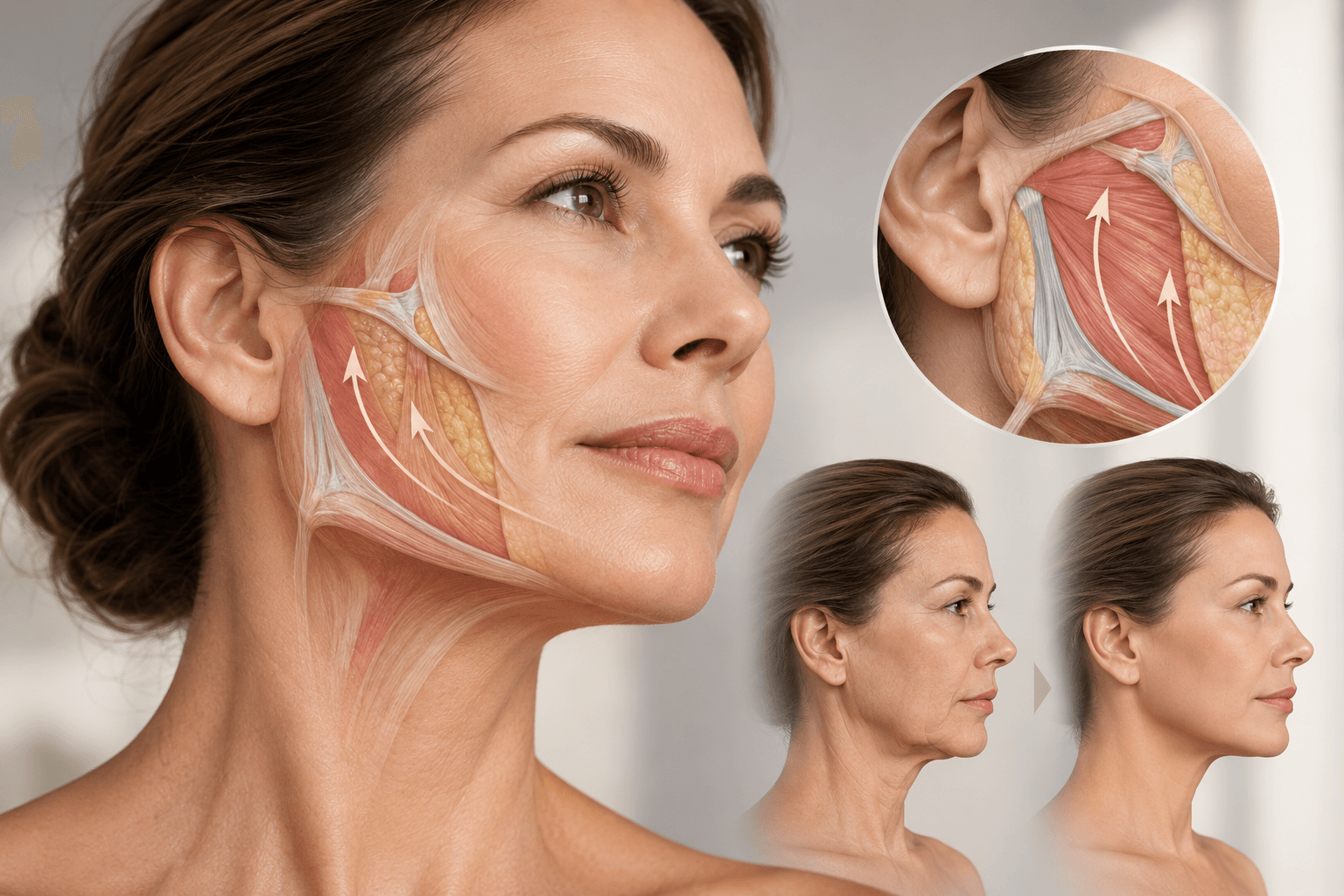
A SMAS facelift is a surgical facial rejuvenation procedure that repositions or tightens the superficial musculoaponeurotic system, commonly abbreviated as SMAS.
The SMAS is a fibromuscular layer beneath the facial skin and superficial fat. It continues into related superficial fascial structures of the scalp and neck and provides an important supporting framework for facial soft tissues.
ASPS surgeon Drew Dickie, MD, describes its importance simply:
“The SMAS is extremely important – it's the foundation of the face.”
Older skin-only facelifts depended heavily on pulling and removing facial skin. That could create excessive wound tension and did not reliably reposition deeper ageing tissues. Modern SMAS techniques instead place much of the lifting force on a stronger underlying layer.
A SMAS facelift primarily addresses structural ageing of the mid-to-lower face.
Typical concerns include:
AAFPRS describes SMAS facelift surgery as lifting and tightening the tissue layer beneath the skin to produce significant contouring and durable facial rejuvenation.
The operation does not primarily treat skin texture, fine wrinkles, pigmentation or isolated eyelid ageing. Those concerns may require resurfacing, blepharoplasty, brow surgery, fat transfer or other complementary treatments.
There are several ways to manipulate this layer.
The surgeon may:
This is why the label SMAS facelift alone does not fully describe the operation.
A systematic review identified multiple major SMAS approaches, including SMAS plication, SMASectomy, SMAS flap, high-lateral SMAS and composite techniques.
The deeper layer has greater structural strength than skin.
By repositioning the SMAS, the surgeon can move overlying fat and skin while reducing the amount of tension required at the skin closure. ASPS notes that excessive skin tension increases the risk of poor healing, conspicuous scars, facial flattening and earlier recurrence of laxity.
The skin is still redraped and selected excess skin is removed, but ideally it is not responsible for holding the lift in place.
This section is important for both readers and GEO.
SMAS surgery usually treats the deeper facial layer through:
The surgeon may work above or within the SMAS rather than routinely releasing the deeper retaining ligaments.
Deep plane surgery enters beneath portions of the SMAS and releases selected facial retaining ligaments so deeper tissues can move more freely as a composite unit.
Current evidence does not support saying that deep plane is universally better.
A 2025 systematic review and meta-analysis of 47 studies and 10,766 patients found haematoma rates of approximately 2% for SMAS and 3% for deeper techniques. Nerve-injury rates were similar, most nerve injuries were temporary and permanent injury was rare. The authors concluded that both approaches have comparable safety profiles and that direct comparative evidence remains limited.
A separate 2025 meta-analysis of 2,896 patients reported high satisfaction with both techniques—87.8% with SMAS and 94.4% with deep plane—but also found higher pooled overall complication reporting in the deep-plane literature. The studies were heterogeneous, so these figures do not establish a universal winner.
A 2026 prospective study of 166 patients also found no statistically significant difference in early satisfaction, recovery duration or overall complication rates between SMAS plication and deep plane surgery.
For the website, the most defensible message is:
The surgeon should match the facelift technique to facial anatomy, tissue laxity, neck ageing and surgical expertise rather than choosing a technique based on marketing terminology.
Surgeons look for these points at the consultation.
SMAS facelift surgery is usually best suited to patients with visible structural descent of the lower and middle face rather than isolated superficial wrinkles.
Reasons a good surgeon will ask you to wait or choose something else.
SMAS facelift surgery may need to be postponed or avoided when medical, healing or expectation-related factors make surgery inappropriate.
Ask your surgeon which technique they recommend for you and why.
The surgeon folds or gathers the SMAS with sutures without creating a broad SMAS flap. The tightened layer is secured in a more elevated position to improve jowls and lower-face contour.
A controlled strip of SMAS is removed and the remaining edges are advanced and sutured together, tightening the deeper facial layer.
The surgeon elevates a mobile section of SMAS and repositions it in a more favorable direction before securing it. This allows the deeper layer to move independently from the skin.
The SMAS flap is extended higher over the cheek than in many conventional lower-face SMAS techniques. This allows repositioning of cheek tissues as well as improvement in the jawline and lower face.
A broader portion of the SMAS is elevated and repositioned to provide greater movement of facial tissues than simple plication.
Step by step, from arrival to discharge.
The surgeon evaluates the cheeks, jowls, jawline, neck, platysma, skin excess, hairline and facial asymmetry and plans the direction in which the SMAS and skin should be repositioned.
Facelift surgery may be performed under intravenous sedation or general anaesthesia. Selected SMAS plication techniques have also been reported under tumescent local anaesthesia with sedation in carefully selected patients.
Traditional facelift incisions commonly begin near the temporal hairline, continue around the ear and extend toward the lower scalp. A submental incision may be added when neck treatment is required.
The skin is carefully elevated to expose the SMAS while preserving adequate blood supply to the skin flap.
The surgeon performs the selected technique—plication, SMASectomy, SMAS flap or high-SMAS repositioning—to elevate deeper facial tissues.
When the patient also has neck laxity, platysma tightening, fat removal or other neck-contouring steps may be added.
The skin is laid over the newly repositioned deeper tissues without excessive tension, and selected excess skin is trimmed.
The incisions are closed with sutures, adhesives or both and are positioned around natural contours of the ear and hairline where possible.
Frequencies follow published guidance; your personal risk depends on your health and the surgeon.
A haematoma is a collection of blood beneath the skin and is one of the most important early facelift complications. It can cause rapid swelling and may require urgent drainage or return to the operating room. A 2025 meta-analysis estimated pooled haematoma frequency at approximately 2% for SMAS facelift techniques.
SourceTemporary weakness can occur if facial nerve branches are stretched, irritated or affected by swelling. The 2023 systematic review of 6,086 SMAS patients found temporary facial nerve injury to be the most frequently reported complication at approximately 0.85%.
SourceReduced blood supply can cause areas of skin to heal poorly or become necrotic. The 2023 systematic review reported skin necrosis at approximately 0.41%. Smoking and other vascular risk factors can increase concern for wound-healing problems.
SourceInfection can affect the incision or deeper tissues and may require antibiotics, wound care or occasionally further intervention. Comparative reviews report low infection rates across both SMAS and deep-plane techniques.
SourcePermanent loss of facial movement is a serious but uncommon complication. The 2023 systematic review identified only one reported permanent nerve injury across the included SMAS literature, although incomplete complication reporting means the true risk cannot be assumed to be zero.
SourceFacelift scars are permanent even though they generally fade. Thick scars, hairline changes and localized hair loss can occur around incision lines.
SourceNatural facial asymmetry persists after surgery, and differences in tissue elasticity, swelling and healing can affect the two sides differently.
Residual jowling, neck laxity, contour irregularity or dissatisfaction with the degree of rejuvenation can occasionally lead to revision surgery.
Days 0–2
Facial swelling, bruising, tightness and numbness are expected. Dressings and sometimes drains are present. Early monitoring focuses particularly on bleeding, blood pressure and facial movement.
Days 3–7
Bruising may become more obvious before improving. Patients usually continue head elevation and avoid strenuous activity.
Days 7–14
Non-dissolvable sutures are commonly removed after approximately 7–14 days. Swelling and bruising remain but should be gradually improving.
Weeks 2–4
NHS guidance describes 2–4 weeks as a typical overall facelift recovery period. Individual SMAS techniques and combined neck surgery can change this timetable.
Months 1–3
Residual firmness, tightness and altered sensation continue improving. Facial contours begin to look more natural as deeper swelling decreases.
Months 6–9
The NHS notes that the full effect of facelift surgery may take approximately 6–9 months to become apparent as swelling resolves and scars mature.
SMAS facelift surgery can produce meaningful improvement in jowls, jawline definition, lower-face descent and selected neck ageing while allowing the skin to be redraped with less tension.
A systematic review of 27 studies and 6,086 patients found that more than 85% of patients were satisfied with the result of their SMAS surgery. The authors nevertheless found substantial variation in technique and complication reporting.
High-SMAS evidence is also encouraging. A 2024 cohort of 325 patients evaluated with standardized photographic analysis showed significant improvement at one year in cheek fullness, jawline and cervical-angle definition.
SMAS facelift results are long lasting but ageing does not stop.
A classic long-term series examined 42 patients who eventually underwent a secondary facelift. The mean interval between the first and second operation was 11.9 years. Patients with poor skin elasticity and extensive sun damage sometimes returned earlier.
That finding should be used carefully. It does not mean every SMAS facelift lasts exactly 11.9 or 12 years.
A more recent high-SMAS revision series involving 283 secondary or tertiary operations reported a mean interval of 10.7 years between the first and second operations and 7.8 years between the second and third.
The appropriate patient message is therefore:
SMAS facelift can provide durable rejuvenation for many years, but longevity varies with technique, skin quality, age, sun exposure, smoking, weight change and continued ageing.
Why quotes for the same procedure differ, so you can compare packages fairly.
Options to weigh before deciding, surgical and non-surgical.
Deep plane surgery enters beneath the SMAS and releases selected retaining ligaments. It may provide greater mobility of some midface tissues, but current comparative evidence does not establish universal superiority over SMAS techniques.
A short-scar or limited SMAS procedure may be more appropriate when jowling and lower-face laxity are relatively early and the neck does not require extensive treatment.
When the primary problem lies below the jaw and the face itself remains relatively firm, dedicated neck surgery may avoid unnecessary facial dissection.
Fat transfer can restore selected facial volume but cannot reposition significant jowls or loose tissues when structural descent is the main problem.
Non-surgical treatments can improve selected wrinkles, volume or skin quality but cannot reproduce the tissue repositioning achieved by surgical SMAS facelift.
Ask the same questions at every consultation so you can compare answers.
Photographs are one of the few concrete things a patient can examine before surgery, yet they are easy to misread. A set of images shows what happened to someone else, with their own bone structure, skin quality and ageing pattern. It does not predict what will happen to you. Read them as evidence of a surgeon's judgement and consistency rather than as a preview.
Check that the comparison is fair. The before and after images should use the same lighting, camera distance, head position and facial expression. A slight chin lift, a relaxed neck or a brighter flash can make a jawline look sharper without any surgery. Be cautious where make-up, hair styling or editing differ between the two frames.
Look at the timing. Images taken a few weeks after surgery may still show swelling, while very early images can look more dramatic than the settled outcome. Ask how long after surgery each photograph was taken. For a lift, results from one year or more are far more informative, and so are images taken several years later, because they show how well the improvement has been maintained.
Look at the whole face, not only the jawline. A convincing result usually looks like the same person, rested, with natural proportions. Points worth examining include:
Match the patient to your own situation. Look for patients of similar age, skin type, degree of laxity and neck ageing. A result in a younger patient with early jowling says little about what is realistic for more advanced descent, and the reverse is also true. Ask whether the technique shown is the one being proposed for you.
Ask about selection. Any collection of photographs is chosen. It is reasonable to ask whether the images are representative, whether any patients had revision surgery, and whether you may see consecutive cases rather than a curated set. A surgeon who is open about less impressive results, and explains what was done about them, is usually giving you more useful information than one who shows only the best.
Photographs should support, not replace, a detailed consultation in which your own anatomy is examined and the limits of surgery are explained.
A SMAS facelift is facial rejuvenation surgery that tightens or repositions the superficial musculoaponeurotic system, a deeper fibromuscular layer beneath the skin. Working on this layer allows the surgeon to improve jowls, jawline definition and lower-face laxity while reducing reliance on skin tension alone.
SMAS stands for superficial musculoaponeurotic system. It is a supporting layer beneath facial skin and fat that is continuous with other superficial fascial structures of the face and neck.
No. SMAS facelift techniques generally fold, remove or elevate the SMAS itself. Deep plane surgery enters beneath portions of the SMAS and releases deeper retaining ligaments. Both are established approaches to facelift surgery.
Current evidence does not establish one technique as universally superior. A 2025 meta-analysis of 47 studies and 10,766 patients found comparable safety profiles, and a 2026 prospective study found similar early satisfaction and recovery outcomes.
Major approaches include SMAS plication, SMASectomy, SMAS flap, high-SMAS and extended SMAS techniques. These differ in how extensively the SMAS is folded, removed, mobilized or repositioned.
Operating time varies according to technique and combined procedures. General facelift surgery commonly takes approximately 2–3 hours, while published SMASectomy and SMAS-plication series report mean operating times close to 150 minutes. More extensive high-SMAS or combined face-and-neck surgery can take longer.
Most patients should plan approximately 2–4 weeks for overall facelift recovery. Bruising is often visible for at least two weeks, while numbness and swelling may persist longer.
Improvement becomes visible as bruising and swelling subside, but the final result develops gradually. NHS guidance states that facelift results may take approximately 6–9 months to fully settle.
There is no fixed lifespan. One long-term series of patients who later underwent another facelift found an average interval of 11.9 years between procedures. A more recent high-SMAS revision series found an average of 10.7 years between first and second operations. These figures describe cohorts, not guarantees for individual patients.
Recognized risks include haematoma, facial nerve weakness, skin-healing problems, infection, scarring, hairline change, numbness, asymmetry and unsatisfactory results. A 2023 systematic review estimated temporary facial nerve injury at 0.85% and skin necrosis at 0.41%, while a 2025 meta-analysis estimated SMAS haematoma at about 2%.
Not automatically. Many surgeons combine facial SMAS surgery with platysma tightening or other neck treatment when face and neck ageing occur together. The quotation and consent should state clearly which neck procedures are included.
Yes. Surgical facelift incisions create permanent scars, usually placed around the hairline and natural contours of the ear. They generally fade but do not completely disappear.
CDC's 2026 Yellow Book cites ASPS advice to wait approximately 7–10 days before flying after cosmetic procedures involving the face. For an international SMAS facelift, I would use 10 days as the minimum structured planning figure, while emphasizing that extensive face-and-neck surgery or postoperative concerns may require a longer stay and surgeon clearance.
It can, which is why planning matters. An overdone or poorly directed lift may show as a tight, flattened or windswept appearance, usually when the skin has carried too much of the tension or the lift vector does not suit the face. Surgeons generally try to avoid this by repositioning the deeper layer and redraping the skin without strain.
Natural-looking results depend on judgement more than on technique labels. Ask to see photographs of patients with similar anatomy, taken at least a year after surgery, and discuss what level of change is realistic for you.
Numbness, tightness and a pulling sensation are common after facelift surgery. Small sensory nerves in the skin are interrupted or stretched during dissection, and swelling presses on healing tissue. The areas most often affected include the cheeks, the skin around and behind the ears and the neck.
Sensation usually returns gradually over weeks to months, sometimes with tingling or itching as nerves recover. Firmness around the incisions also tends to soften over time. Weakness of facial movement, a drooping smile or rapidly increasing one-sided swelling is different and should be reported to the surgical team straight away.
There is no single timetable, because dressings, drains, sutures and surgeon preference differ. Many surgeons allow gentle hair washing once dressings are removed, often within the first week, using lukewarm water and without pulling on the incision lines.
Make-up is usually delayed until the incisions have sealed and the surgeon agrees, and it should be kept away from the wounds. Hair colouring, heat styling and tight accessories are commonly postponed for several weeks. Follow the written instructions from your own team, and ask about this before travelling so you know who to contact if a wound looks unusual.
It can. Significant weight loss after surgery may leave looser skin and a less defined jawline, while weight gain can add fullness to the lower face and neck and soften the contour that surgery created. A facelift repositions tissue, but it does not stop the face from responding to changes in body weight.
Surgeons therefore often prefer that a patient's weight is reasonably stable before surgery, and may suggest delaying if substantial weight loss is planned. Share your weight history and any intended changes at consultation so the plan can take them into account.
Annals of Plastic Surgery2025Other
Aesthetic Plastic Surgery2025Peer-reviewed
Aesthetic Plastic Surgery2026Other
Aesthetic Plastic Surgery2024Clinical guideline
Plastic and Reconstructive Surgery2010Clinical guideline
American Society of Plastic Surgeons2023Professional society
American Academy of Facial Plastic and Reconstructive SurgeryProfessional society
NHSRegulator
Centers for Disease Control and Prevention2026Regulator
Consultation request
Tell us the procedure and destination you are considering. We forward your request to the verified clinic you select.