
Loading
Procedure guide · Face
 Upper Eyelid Surgery
Upper eyelid surgery, also called upper blepharoplasty, removes excess skin and sometimes small amounts of fat from the upper eyelids. It is commonly used to improve hooded or heavy-looking eyelids and can also help when excess skin partly blocks the upper field of vision. Surgery is usually performed through the natural eyelid crease and is often a same-day procedure. Most patients look socially presentable within about 10–14 days, while scars and residual swelling continue improving over the following months.
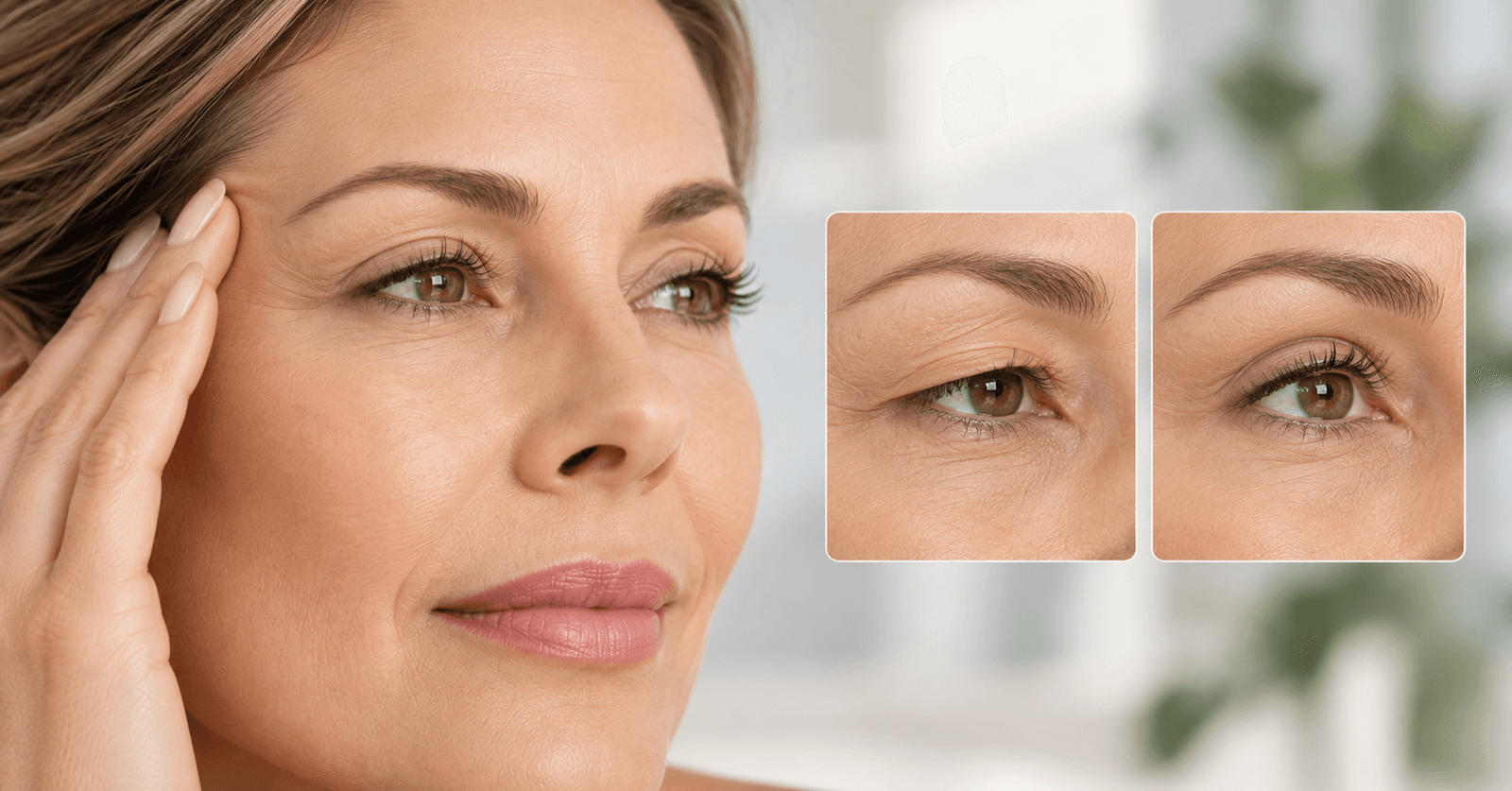
Upper eyelid surgery, or upper blepharoplasty, is an operation that removes or reshapes excess tissue from the upper eyelid.
The most common reason is excess skin that makes the eyelids appear:
Sometimes the skin hangs far enough over the eyelid to interfere with vision.
ISAPS describes upper blepharoplasty as surgery that improves the contour of the upper eyelid by removing excess skin and, when necessary, small pockets of fat.
The goal should be to make the eye area look more open and refreshed while still looking natural.
The operation may involve:
However, modern surgery is usually conservative.
Removing too much skin or muscle can make the eyes look hollow or can make it difficult to close the eyelids properly.
A 2025 meta-analysis found that removing muscle together with skin was associated with a higher risk of lagophthalmos, meaning incomplete eyelid closure, compared with skin-only surgery.
For normal patients reading this page, the simplest message is:
More tissue removal does not automatically mean a better result.
Upper blepharoplasty may improve:
A systematic review of 28 studies found that upper blepharoplasty can improve visual field and vision-related quality of life in patients with functional eyelid problems.
This distinction is extremely important.
Treats excess skin and tissue above the eye.
The eyelid edge itself may still be sitting at a normal height.
Treats a low eyelid margin.
This happens when the muscle that lifts the eyelid is weak or stretched.
AAO EyeWiki explains that dermatochalasis—extra eyelid skin—is different from true eyelid ptosis, even though the two can happen together.
If a surgeon removes skin without recognizing true ptosis, the eye may still look droopy afterward.
A low eyebrow can also push skin downward and create the appearance of heavy upper eyelids.
ASPS surgeon Kelly Sullivan, MD, explains:
“I can't talk about upper blepharoplasty without talking about a brow lift.”
Her point is that the brow and eyelid should be assessed together.
A patient may need:
Cambridge University Hospitals similarly notes that brow droop can be the main cause of overhanging upper-eyelid skin in some patients.
It should not dramatically change the natural identity of the eyes when performed conservatively.
The aim is generally to:
ASPS surgeon Christopher Hadeed, MD, describes conservative upper blepharoplasty as a way to open the eyes without dramatically changing their appearance.
Over-removal of skin or fat can create an unnatural or hollow appearance, which is why conservative planning matters.
Surgeons look for these points at the consultation.
Upper eyelid surgery may suit patients who have excess upper-eyelid skin or puffiness and want a more open, less heavy appearance.
Reasons a good surgeon will ask you to wait or choose something else.
Upper blepharoplasty may need to be delayed or reconsidered when another condition is actually causing the problem.
Ask your surgeon which technique they recommend for you and why.
The surgeon removes the extra upper-eyelid skin through an incision placed in the natural eyelid crease.
The surgeon removes extra skin and carefully removes or repositions a small amount of fat when puffiness is present.
A small strip of the muscle just beneath the eyelid skin may be removed together with the skin in selected patients.
Step by step, from arrival to discharge.
The surgeon checks how much skin is present, whether fat is bulging, where the eyebrow sits and whether the actual eyelid margin is drooping. This step prevents conditions such as brow ptosis or true eyelid ptosis from being mistaken for simple excess skin.
The surgeon marks the amount of skin that can be safely removed while the patient is awake and sitting upright. The goal is to leave enough skin for comfortable eye closure.
Upper blepharoplasty is commonly performed under local anaesthesia. Sedation or general anaesthesia may be used depending on the patient, surgeon and whether other procedures are being performed.
A fine incision is made along the normal fold of the upper eyelid. This position helps hide the scar when the eye is open.
The surgeon removes the planned amount of skin and, when necessary, carefully adjusts small amounts of fat or muscle.
The incision is closed with fine sutures or skin adhesive. Sutures that need removal are commonly taken out within approximately 1 week.
Frequencies follow published guidance; your personal risk depends on your health and the surgeon.
The eyes may feel dry, gritty, watery or sensitive while swelling settles. Lubricating drops or ointment are often used during early recovery.
SourceNo two eyelids are perfectly identical before surgery. Swelling can temporarily make them look different, and some asymmetry may remain after healing. A 2024 systematic review identified asymmetry as an important cause of dissatisfaction after upper-eyelid surgery.
SourceThe scar is usually hidden in the eyelid crease and fades over time, but scars can remain visible or become thicker in some patients.
SourceAs with any surgery, infection or bleeding can occur. Increasing pain, swelling, redness or discharge should be reported promptly.
SourceSwelling or excessive skin removal can make it harder to close the eyelids completely. A 2025 meta-analysis found higher rates when both eyelid skin and muscle were removed compared with skin-only surgery.
SourceBleeding inside the eye socket can place pressure on the eye and threaten vision. Sudden severe pain, rapidly increasing swelling or a change in vision requires urgent medical attention.
SourceThe eyelids usually look swollen and bruised during the first days. CUH notes that bruising commonly settles within about 2 weeks.
SourceDays 0–3
The eyelids are usually swollen, bruised and slightly uncomfortable. The eyes may feel watery, dry or sensitive. Cold compresses and prescribed lubricating ointment may be recommended.
Days 4–7
Swelling begins to settle. Sutures or supporting strips are commonly reviewed or removed around the end of the first week.
Days 7–14
Bruising continues fading. ASPS reports that most eyelid-surgery patients are presentable in public within approximately 10–14 days.
Weeks 3–6
Residual swelling continues improving and the eyelid crease becomes softer. The scar may still look pink but becomes less noticeable.
Months 2–3
The eyes generally look more natural as swelling and tightness disappear.
Several Months
The eyelid scar continues flattening and fading. ASPS notes that complete healing can take several months even though patients look socially recovered much earlier.
Upper eyelid surgery can make the eyes appear:
Results should still look like your own eyes.
A systematic review of 26 studies found that patients were generally satisfied with the aesthetic results and scar appearance after upper blepharoplasty.
A newer 2025 review of 12 randomized trials and 450 patients also found high satisfaction and supported conservative surgical techniques.
For patients whose excess skin was affecting vision, upper blepharoplasty may also improve the visual field.
The result is generally long-lasting, although the forehead, eyebrows and remaining eyelid skin continue to age naturally. ASPS describes eyelid-surgery results as long-lasting rather than permanent protection against future ageing.
Why quotes for the same procedure differ, so you can compare packages fairly.
Options to weigh before deciding, surgical and non-surgical.
If a low eyebrow is pushing skin downward over the eyelid, raising the brow may be more appropriate than simply removing more eyelid skin.
If the eyelid margin itself sits too low because the lifting muscle is weak or stretched, ptosis repair treats the underlying muscle problem. Blepharoplasty alone does not correct true ptosis.
Selected treatments may improve fine skin texture or mild crepey skin, but they cannot remove a large fold of excess upper-eyelid skin.
Hooded eyelids are often a normal inherited or age-related feature. Surgery is only needed when the patient personally wants treatment or excess skin is affecting vision.
Ask the same questions at every consultation so you can compare answers.
Photographs are the most useful evidence a patient can ask to see, and also the easiest to misread. Eyelids are small, and a few millimetres of difference in lighting, camera angle or eyebrow position can change how heavy or open they appear. Looking at photographs carefully helps you judge a surgeon's style and restraint rather than simply hoping for a dramatic contrast.
Check that the conditions match. A fair comparison uses the same camera distance, the same lighting, the same facial expression and the same head position before and after. Raised eyebrows, a slight chin lift or a wider gaze in the later image can make eyelids look more open without any difference in the operation. If the eyebrows sit noticeably higher in one picture, the change may come from the expression and not from the surgery.
Look at the timing. Photographs taken within the first weeks show swelling, redness and a raised, pink scar. Photographs taken several months later show a more settled result. A good set of images states roughly how long after surgery each one was taken. Be cautious when no interval is given, because a result that looks excellent at one week and one that looks excellent at one year are not the same claim.
Look for patients like you. Upper eyelids differ in skin thickness, crease position, fat distribution and brow height. A result in a patient with thin skin and a high crease tells you little about what to expect with thick skin and a low brow. Ask for examples that resemble your own anatomy, including cases where a brow lift or ptosis repair was also needed.
Study the details, not only the overall impression.
Remember what photographs cannot show. They do not show dryness, irritation, tightness or how the eyes feel in wind and air conditioning. They also cannot show the cases that went less smoothly. It is reasonable to ask a surgeon how often revision is needed and what the plan would be if the outcome were uneven.
Treat very uniform results with some caution. Natural faces are asymmetrical, and an honest portfolio contains results that look natural and individual rather than identical. If every image appears edited, cropped tightly or shot under different conditions, that is a reason to ask more questions.
Finally, a gallery shows what one surgeon has achieved in some patients. It is not a prediction for you. The surgeon's assessment of your own skin, brow and eyelid margin remains the more reliable guide, and an honest surgeon will describe limits as readily as possible improvements.
The recovery timeline on this page shows the usual sequence. What patients often want to know is how to tell an ordinary healing pattern from something that deserves a call. The distinction is mostly about direction of change, symmetry and severity.
Usually expected during healing
Worth reporting to the surgical team promptly
Needs urgent medical attention
These symptoms can indicate bleeding behind the eye or another problem that needs treatment without delay. Do not wait for the next scheduled appointment. If you have travelled for surgery, ask beforehand how you can reach the team, and where you could be seen locally if you are home when a problem arises.
Why timing matters. Most concerns are about patience. Eyelid skin swells readily, so a result judged at two weeks is not a result judged at three months. Many surgeons suggest waiting several months before deciding whether any refinement is needed, unless a functional problem such as incomplete closure is present. Keep your follow-up appointments, take clear photographs in the same light each week so that change is easier to judge, and write down questions between visits.
Upper eyelid surgery, or upper blepharoplasty, removes excess skin and sometimes small amounts of fat or muscle from the upper eyelids. It is used to improve hooding or heaviness and can also improve vision when excess skin blocks part of the visual field.
Yes. Upper blepharoplasty is the medical name for upper eyelid surgery.
No. Blepharoplasty removes extra skin or tissue. Ptosis surgery repairs the mechanism that lifts an eyelid whose edge sits too low. The two problems can occur together.
Yes, when excess skin is hanging far enough to obstruct the upper or side field of vision. Research has found improvements in visual field and vision-related quality of life after functional upper blepharoplasty.
Upper-eyelid-only surgery is often completed in roughly 45–90 minutes, although operating time varies. NHS guidance gives a broader 45-minute to 2.5-hour range for eyelid surgery depending on how many eyelids are treated.
Not necessarily. Many isolated upper blepharoplasties can be performed under local anaesthesia. Sedation or general anaesthesia may be used depending on the patient and whether other procedures are being combined.
Most patients should expect bruising and swelling for approximately 1–2 weeks. ASPS states that many patients are comfortable appearing in public after about 10–14 days.
Sutures that are not dissolvable are commonly removed within approximately 1 week.
Yes, but the incision is usually placed directly in the natural upper-eyelid crease so the scar becomes difficult to see as it fades.
Temporary dryness or irritation can occur. Patients who already have dry-eye symptoms should tell the surgeon before surgery so the eye surface and eyelid closure can be assessed.
Yes. Excessive removal can make it difficult to close the eyes normally and can produce an unnatural appearance. This is one reason modern upper blepharoplasty is generally conservative.
A conservative operation should mainly improve hooding while preserving the patient's natural eye shape. Over-aggressive removal can change the appearance, which is why careful planning is important.
Results are typically long-lasting, but ageing continues and the eyebrows and remaining skin may gradually descend over time.
For medical-tourism planning, the CDC cites ASPS advice to wait 7–10 days before flying after cosmetic eyelid procedures. Ideally, patients should remain long enough for an early review and suture removal before travelling home.
Most surgeons ask patients to keep makeup away from the incisions until the stitches are out and the skin has closed fully, which is usually around one to two weeks. The exact timing depends on how your wounds are healing, so follow your own surgeon's instructions.
When you do restart, use clean, new products rather than old ones, because old mascara and liner can carry bacteria. Apply gently, avoid dragging or rubbing the eyelid, and remove makeup with care using a soft, non-irritating method. If the area becomes sore, red or watery, stop and ask the team for advice.
Many patients return to desk-based work within about one to two weeks, partly because of how the eyes look and partly because screens and reading can be tiring while the eyes are dry. Work involving dust, chemicals or heavy lifting may need more time.
Strenuous exercise raises blood pressure and can increase swelling or bleeding, so it is usually postponed for a few weeks. Your surgeon will give a specific date based on how you are healing. Gentle walking is often accepted earlier. Swimming is normally avoided until the incisions have healed, because of the infection risk from water and the irritation from chlorine.
Yes, this is common. Swelling and bruising rarely settle at exactly the same rate on both sides, and most people also have a small natural difference between their eyelids before surgery. Temporary unevenness in the early weeks therefore does not mean the result will stay uneven.
Contact your surgical team if the difference is increasing, if one side is very tense or painful, or if you notice a change in vision. Otherwise, many surgeons advise waiting several months for the tissues to settle before judging symmetry or considering any refinement.
A revision is sometimes possible, but it is planned more cautiously than a first operation. The tissues have already been altered, scar tissue may be present, and there is less spare skin to work with.
Surgeons usually wait for several months, until swelling has settled and the scars have matured, before considering any further surgery. The reason for revision matters. Mild asymmetry may be improved with a small adjustment, while a problem such as incomplete eyelid closure needs careful assessment of what tissue is available. If you are thinking about revision, a second opinion from a surgeon who regularly performs eyelid surgery is reasonable, and original operation notes can help.
The anaesthetic means you should not feel sharp pain during the operation, although some people notice pressure or tugging if it is done awake. Afterwards, most patients describe tightness, tenderness and a pulling feeling more than strong pain, but experience varies from person to person.
Discomfort is usually greatest in the first few days and is often controlled with simple pain relief and cold compresses, as advised by your surgeon. Pain that is severe, getting worse or accompanied by sudden swelling or a vision change is not part of routine healing and should be reported urgently.
Yes, they are often combined when a patient has both loose upper skin and lower-eyelid changes such as under-eye bags. Combining them means one anaesthetic and one recovery period, but it also means more swelling and a somewhat longer period before the eyes feel settled.
The two operations treat different problems and are planned separately. Some patients need only the upper lids. Others may be better treated with a staged approach, particularly if they have dry eyes or other risk factors. Ask your surgeon why they recommend a particular combination, and what would be left untreated if you chose upper lids alone.
Keep the incision clean and follow the wound care you were given. Once the stitches are out and the skin has closed, your surgeon may suggest gentle care of the scar, but you should not massage, rub or apply products to it unless you have been told it is safe.
Sun protection matters, because ultraviolet light can darken a healing scar. Sunglasses and a broad-brimmed hat are useful in the early months, and sunscreen can be used on the scar once your surgeon agrees. Scars fade gradually over several months. If one becomes thick, raised, itchy or darker, tell your surgeon, because early advice can help.
Aesthetic Plastic Surgery2023Peer-reviewed
Aesthetic Surgery Journal2025Peer-reviewed
Journal of Plastic, Reconstructive & Aesthetic Surgery2019Peer-reviewed
NHSRegulator
American Society of Plastic SurgeonsProfessional society
American Society of Plastic SurgeonsProfessional society
American Academy of Ophthalmology EyeWiki2026Clinical guideline
Centers for Disease Control and Prevention2026Other
Consultation request
Tell us the procedure and destination you are considering. We forward your request to the verified clinic you select.