
Loading
Procedure guide · Face
 Deep Plane Facelift
Deep plane facelift surgery repositions descended facial tissues by dissecting beneath the superficial musculoaponeurotic system (SMAS) and releasing selected retaining ligaments so the skin and deeper tissues can move together. It is used to improve jowls, jawline laxity, marionette lines and selected midface and neck ageing. Surgery is usually performed under general anaesthesia or sedation, recovery commonly takes about 2–4 weeks, and final results continue settling for 6–9 months. Current evidence does not prove that deep plane surgery is universally superior to SMAS facelift techniques.
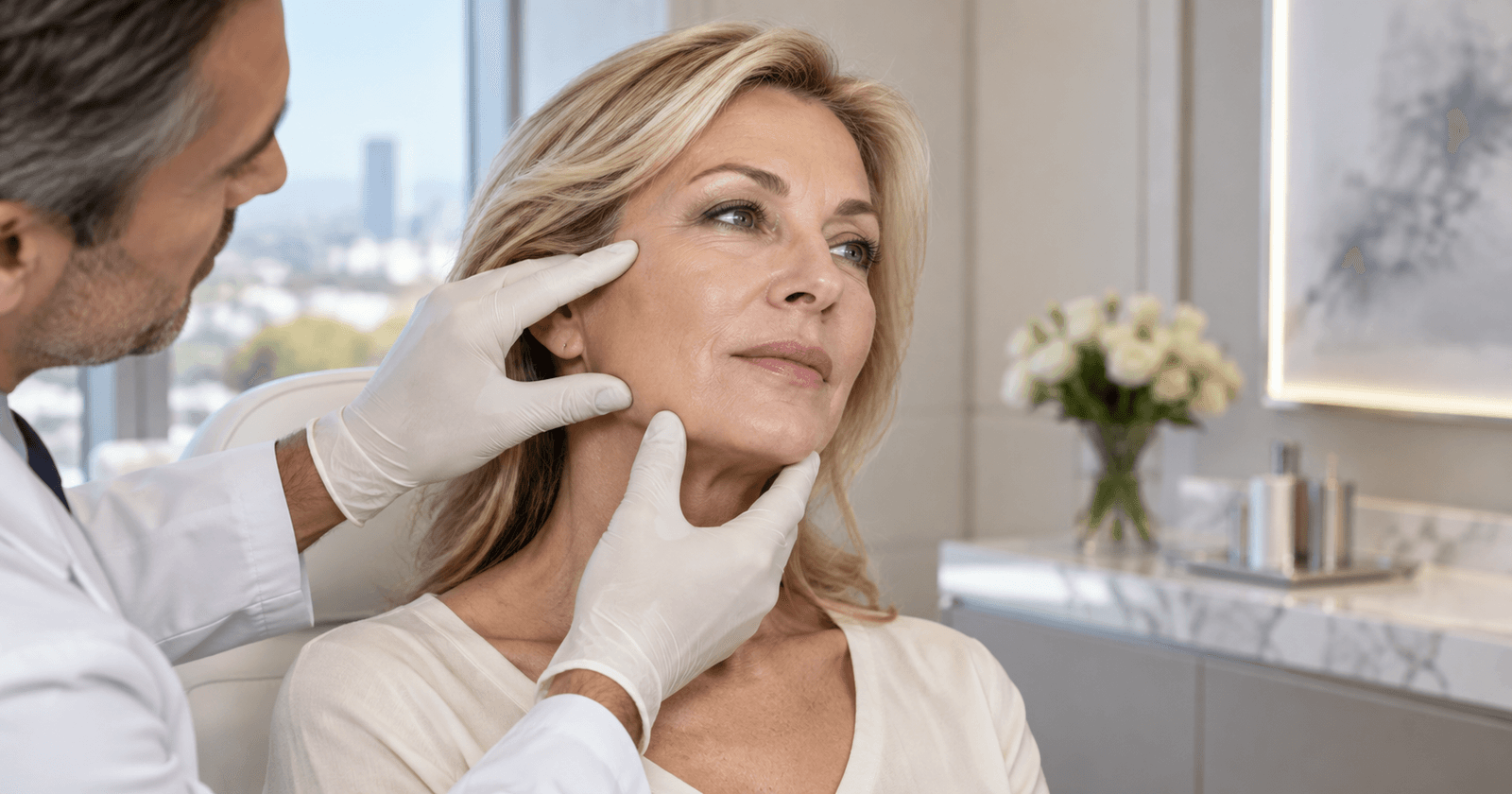
A deep plane facelift is a facelift technique that repositions deeper facial tissues rather than relying mainly on pulling and trimming skin.
The key anatomical layer is the superficial musculoaponeurotic system, or SMAS. The SMAS is a fibromuscular layer beneath the skin and facial fat that is connected to the muscles responsible for facial expression.
In deep plane surgery, the surgeon enters a plane beneath the SMAS in selected areas and releases specific retaining ligaments—fibrous attachments that tether soft tissues to deeper facial structures. Once these attachments are released, the cheek, jowl and lower-face tissues can be mobilized as a more unified layer.
ASPS surgeon Darrick Antell, MD, summarizes an important principle:
“The best facelift really depends on the individual's anatomy.”
That is the correct way to position this procedure. “Deep plane” should describe how the operation is performed, not serve as a marketing label implying that every patient needs the same technique.
The face contains multiple tissue layers.
From superficial to deep, these broadly include:
A conventional SMAS facelift usually elevates the skin and then tightens, folds or repositions the SMAS separately.
In a deep plane facelift, the surgeon dissects beneath portions of the SMAS and releases selected ligaments. This allows skin, superficial fat and SMAS to move together as a composite flap rather than placing the lifting force primarily on the skin.
ASPS explains that the deep plane technique works below the SMAS and releases facial ligaments to mobilize deeper tissues.
Deep plane facelift surgery can address several age-related changes at the same operation.
Typical concerns include:
ASPS surgeon Omar Hussain, MD, describes deep plane surgery as particularly useful for patients with prominent nasolabial folds, marionette lines, jowls and platysmal bands.
The amount of midface improvement depends on how far the surgeon extends the ligament release and dissection.
An extended deep plane facelift expands the deep-plane dissection farther into the cheek or lower face than some conventional deep-plane variations.
The objective is to release additional retaining ligaments and mobilize tissues that contribute to:
A 2026 study comparing deep plane and extended deep plane surgery in 70 patients found that both improved lower facial ageing, while the extended approach produced greater measured improvement in marionette lines, jowls and neck laxity at nine months. No permanent facial nerve injuries or major complications were reported in that study.
However, one relatively small study should not be interpreted as proving that extended dissection is required for every patient.
This is an essential comparison for the page.
The surgeon enters beneath the SMAS in selected areas and releases retaining ligaments so the SMAS, overlying fat and skin can be repositioned together.
Potential advantages include:
Potential disadvantages include:
SMAS facelift surgery manipulates the SMAS through techniques such as plication, imbrication, SMASectomy or flap elevation.
Potential advantages include:
Potential disadvantages depend heavily on which SMAS technique is being discussed; “SMAS facelift” is not one single operation.
A 2025 meta-analysis of 47 studies and 10,766 patients found haematoma rates of about 3% for deep techniques and 2% for SMAS, while nerve injury rates were similar and permanent facial nerve injury was rare. The authors concluded that both had comparable safety profiles and that evidence was insufficient to declare one universally more effective.
A 2026 prospective cohort of 166 patients likewise found no statistically significant differences in early patient satisfaction, recovery duration or overall complications between deep plane and SMAS plication.
The technique is designed to transfer lifting force to deeper facial tissues rather than relying on excessive skin tension.
This can help avoid an obviously pulled skin appearance when the operation is well planned and performed.
AAFPRS President Patrick Byrne, MD, describes well-performed deep plane results as potentially “extremely natural-looking,” while also emphasizing that outcome depends on the surgeon's experience, judgment and application of the technique.
Naturalness is therefore not guaranteed merely because an operation carries the name “deep plane.”
Poor planning, excessive movement or inappropriate patient selection can still produce an unnatural result.
No facelift permanently stops ageing.
One of the strongest recent longevity datasets was published in 2026 and examined patients who eventually returned for additional facelift surgery following a previous deep plane facelift.
Among 77 patients undergoing a second facelift, the average interval between the first and second operations was 10.9 ± 5.1 years. Patients who had their first operation at age 53 or younger returned after an average 12.4 years, compared with 9.3 years among those older than 53.
This study has an important limitation: it only looked at patients who ultimately returned for another operation. It therefore cannot tell us that every deep plane facelift “lasts 10.9 years.”
It does, however, provide useful real-world evidence that meaningful results can persist for many years.
Surgeons look for these points at the consultation.
Deep plane facelift surgery is most appropriate when ageing involves meaningful descent of deeper facial tissues rather than only fine wrinkles, minor skin laxity or isolated volume loss.
Reasons a good surgeon will ask you to wait or choose something else.
Deep plane facelift surgery may need to be postponed or avoided when medical or healing risks outweigh expected benefit.
Ask your surgeon which technique they recommend for you and why.
The surgeon enters beneath the SMAS in selected areas and releases facial retaining ligaments so descended cheek, jowl and lower-face tissues can be repositioned as a composite unit.
The deep-plane dissection and ligament release are extended farther to allow greater mobilization of descended tissues around the cheek, marionette region, jowls and sometimes the neck.
Deep plane facial repositioning is combined with neck surgery when platysmal laxity, submental fullness or loose neck tissues contribute to the patient's concern.
Step by step, from arrival to discharge.
The surgeon assesses midface descent, jowls, neck anatomy, retaining-ligament position, hairline, previous scars and facial asymmetry. Incision and lift vectors are marked before anaesthesia.
Deep plane facelift surgery may be performed under general anaesthesia or intravenous sedation in an appropriately accredited surgical facility. ASPS describes both approaches as being used for facelift surgery.
Incisions typically begin around the temporal hairline, continue around the ear and extend behind the ear toward the scalp. Their exact placement depends on hairline, sex, anatomy and whether the neck is also treated.
The surgeon elevates the necessary skin exposure and enters the plane beneath the SMAS in selected regions, allowing access to deeper facial retaining ligaments.
Selected retaining ligaments are released so cheek, jowl and lower-face tissues can be mobilized without relying predominantly on skin traction. This ligament release is one of the defining features of deep plane surgery.
The mobilized SMAS, facial fat and overlying tissues are lifted and secured in a position designed to restore cheek support, improve jowls and redefine the jawline.
When neck ageing is present, the operation may include platysma tightening, fat treatment or deeper neck contouring. The precise neck plan should be stated separately during consent.
The skin is laid over the newly repositioned deeper tissues with reduced tension, selected excess skin is removed and incisions are carefully closed.
Dressings are applied and drains may be used depending on the surgeon. Patients are monitored for bleeding, swelling, blood-pressure changes and facial movement during early recovery.
Frequencies follow published guidance; your personal risk depends on your health and the surgeon.
A haematoma is a collection of blood beneath the skin and is an important early facelift complication. It can cause sudden swelling, pain or pressure and may require urgent return to theatre for evacuation and bleeding control. The 2026 deep-plane meta-analysis estimated haematoma at 1.8%.
SourceFacial nerve branches control facial movement. Temporary weakness can occur because of traction, swelling or nerve irritation during deep dissection. The 2026 meta-analysis estimated temporary facial nerve injury at 1.2%.
SourceA seroma is a collection of clear fluid beneath the tissues. Small collections may resolve with observation or aspiration; persistent collections may require additional treatment. The pooled estimate was 1.7%.
Facelift scars usually mature gradually around the ear and hairline, but some patients develop thicker, raised or conspicuous scars. The pooled hypertrophic-scar rate was 2.8% in the 2026 deep plane review.
Infection can affect the incisions or deeper tissues and may require antibiotics, wound care or occasionally further treatment. The 2026 meta-analysis estimated infection at 0.8%.
Reduced blood supply can cause skin loss, particularly in patients with impaired circulation or nicotine exposure. The pooled deep-plane estimate was 0.1%.
Permanent motor nerve injury is one of the most feared complications because deep-plane dissection occurs near facial nerve branches. No permanent facial nerve injuries were observed across the 10,784 patients included in the 2026 meta-analysis, but this does not establish that the risk is zero.
Natural facial asymmetry remains after surgery. Differences in swelling, scar formation, tissue elasticity and continued ageing can also influence the final result. Revision surgery may occasionally be considered. The NHS notes that asymmetry and failure to achieve the desired result are recognized facelift outcomes.
Days 0–2
Swelling, bruising, tightness and numbness are expected. Dressings and sometimes drains are present. The early priority is monitoring for haematoma, blood-pressure elevation and unexpected facial weakness.
Days 3–7
Bruising can become more visible before it begins to improve. Patients should rest with the head elevated and avoid strenuous activity. NHS guidance advises keeping the head supported with pillows during early recovery.
Days 7–14
Non-dissolvable sutures are often removed within approximately 7–14 days. Patients become increasingly socially presentable, although swelling and bruising remain.
Weeks 2–4
The NHS describes typical facelift recovery as 2–4 weeks. A 2026 prospective study found median recovery durations around 30 days for deep plane and 25.5 days for SMAS plication, with no significant difference between the groups.
Months 2–3
Residual swelling and firmness continue to improve, and incisions begin maturing. Numbness or altered sensation may still be present.
Months 6–9
The NHS states that the full effect of facelift surgery can take around 6–9 months to become apparent as swelling decreases and scars mature.
A successful deep plane facelift can improve jowling, restore jawline definition, elevate descended cheek tissues and produce a smoother transition between the cheek, lower face and neck.
Results are long lasting, but not permanent. Ageing, skin changes, weight fluctuations and changes in facial volume continue after surgery.
A 2026 longevity study reviewed patients who ultimately underwent another facelift after a previous deep plane procedure. The mean interval to a second facelift was 10.9 years, while patients who underwent their first operation at age 53 or younger returned after an average 12.4 years.
This should not be rewritten on the website as “a deep plane facelift lasts exactly 10.9 years.” The study only included patients who returned for another facelift.
Comparative evidence should also be presented carefully. A 2025 meta-analysis reported high satisfaction with both techniques—94.4% for deep plane and 87.8% for SMAS—but pooled complication reporting varied substantially.
A different 2025 meta-analysis of 47 studies concluded that deep and SMAS approaches had broadly comparable safety profiles and that limited direct comparative data prevented definitive conclusions about which provides better overall results.
The most defensible patient message is therefore:
Deep plane facelift can provide powerful, durable facial rejuvenation, but surgeon judgment, anatomy and appropriate technique selection matter more than the procedure name alone.
Why quotes for the same procedure differ, so you can compare packages fairly.
Options to weigh before deciding, surgical and non-surgical.
A SMAS facelift tightens or repositions the superficial musculoaponeurotic system using plication, imbrication, SMASectomy or flap techniques. Evidence shows strong outcomes with both SMAS and deep plane surgery, and neither should be assumed to be universally superior.
A limited-incision facelift can suit selected patients with earlier or less extensive lower-face laxity. It generally provides less extensive correction than a full deep plane procedure.
When the face and jawline remain relatively firm but the primary concern is loose skin or platysmal laxity below the jaw, a neck-focused procedure may avoid unnecessary facial dissection.
Volume loss can sometimes make facial ageing appear worse even without major tissue descent. Fat transfer can restore selected volume but cannot reposition significant jowls or loose facial tissues.
Non-surgical options can improve volume, wrinkles or selected skin-quality concerns but cannot reproduce the deep tissue repositioning of a facelift when significant facial descent is present. ASPS notes that nonsurgical treatments do not achieve the same result as surgical tissue lifting.
Ask the same questions at every consultation so you can compare answers.
A deep plane facelift is a facial rejuvenation operation in which the surgeon works beneath the SMAS and releases selected retaining ligaments so descended facial tissues can be mobilized and repositioned together. It is commonly used to improve jowls, jawline laxity, marionette lines and selected midface and neck ageing.
Deep plane surgery enters beneath the SMAS and releases facial retaining ligaments to increase tissue mobility. SMAS facelift surgery generally tightens, folds, removes or elevates the SMAS through techniques such as plication or imbrication. Both can produce strong results, and current evidence does not establish one as universally superior.
Not necessarily. A 2025 systematic review reported high satisfaction with both techniques, while another meta-analysis and a 2026 prospective cohort found insufficient evidence for a universal advantage. Anatomy, surgeon expertise and how the technique is performed are central to outcome.
Results are long lasting but ageing continues. A 2026 study of patients who eventually returned for another deep plane facelift found an average 10.9-year interval between their first and second procedures. This does not mean every deep plane facelift has an exact 10.9-year lifespan.
Most patients should plan several weeks rather than several days. General NHS facelift guidance describes 2–4 weeks of recovery. In a 2026 prospective comparison, median recovery was approximately 30 days after deep plane surgery, similar to SMAS plication.
The face begins looking more settled as swelling improves during the first few weeks, but final results develop much more slowly. NHS guidance states that the full effect of facelift surgery may take approximately 6–9 months to become apparent.
Risks include haematoma, temporary or permanent facial nerve injury, seroma, infection, scarring, skin-healing problems, asymmetry and revision surgery. A 2026 meta-analysis of 10,784 deep plane patients reported pooled rates of 1.8% for haematoma, 1.2% for temporary facial nerve injury, 1.7% for seroma and 0.8% for infection.
Permanent injury appears rare in published series. A 2026 meta-analysis found temporary facial nerve weakness in approximately 1.2% of patients and reported no permanent facial nerve injuries among the included studies. However, this does not mean permanent injury is impossible, and outcomes depend on surgical technique and reporting quality.
It can, but not automatically. Many patients have lower-face and neck ageing together, so surgeons frequently combine deep plane facial repositioning with neck treatment. The surgical plan should state clearly whether platysma tightening, neck fat treatment or other neck procedures are included.
No. Blepharoplasty is a separate operation. It can be performed at the same time when eyelid ageing contributes to the patient's overall concern, but it should be discussed and consented to separately.
A deep plane facelift patient should remain close enough to the surgical team for early follow-up and management of bleeding or wound problems. ASPS surgeon Darrick Antell reports that many international patients in his practice are able to fly at around 10 days, but the operating surgeon must provide individualized clearance and more extensive surgery may justify a longer stay.
The technique is designed to reposition deeper tissue while reducing reliance on skin tension, which can help produce a natural result. However, “deep plane” does not guarantee naturalness; outcome still depends on surgical judgment, tissue movement and avoiding overtreatment.
Yes, some numbness, tightness and altered sensation are expected. Small sensory nerves in the skin are stretched or divided during any facelift, so the cheeks, jawline and the area around the ears often feel dull or strange for weeks.
Sensation usually returns gradually over several months, although some areas can stay slightly altered for longer. Tell your surgeon if numbness is accompanied by weakness when smiling, raising the brows or closing the eyes, because that needs prompt assessment. Gentle massage or creams should only be used if the surgeon has approved them.
Mild differences in swelling and bruising between the two sides are common, because tissues rarely heal at exactly the same pace and most people sleep more on one side. This often settles over the first weeks.
Sudden, tense or rapidly increasing swelling on one side, particularly with pain, pressure or a dark discolouration, is different. It may signal a collection of blood and should be reported to the surgical team immediately rather than watched at home, especially in the first days after surgery. Keeping the head raised, as instructed, helps to limit swelling on both sides.
Incisions around the temple and behind the ear can shift the position of the hairline slightly, and the surgeon plans their placement according to your hairline, hair density and whether the sideburn area should be preserved. Men are often marked differently because of beard-bearing skin.
Some temporary thinning near the incisions can occur, and occasionally hair loss along a scar persists. Ask how the incisions will be designed for your hair pattern, what happens to the sideburn, and how any hair-bearing skin will be handled before surgery. Photographs of your hairline taken at the consultation make later comparison easier.
There is no single timetable, because it depends on wound healing and the surgeon's instructions. Make-up is usually avoided until the incisions have closed and the surgeon confirms that it is safe, and hair colouring is often delayed until the scalp and hairline incisions are well healed.
Light walking is generally encouraged early, but strenuous exercise, heavy lifting and activities that raise blood pressure are usually postponed for several weeks to reduce bleeding risk. Follow your own written instructions, and check any plan with the operating surgeon before resuming. Sun protection on healing scars matters too, so a hat and sunscreen are usually advised once wounds have closed.
Aesthetic Plastic Surgery2026Peer-reviewed
Annals of Plastic Surgery2026Peer-reviewed
Aesthetic Plastic Surgery2025Peer-reviewed
Aesthetic Plastic Surgery2026Professional society
Facial Plastic Surgery & Aesthetic Medicine2026Clinical guideline
American Society of Plastic Surgeons2025Professional society
NHS2023Regulator
American Academy of Facial Plastic and Reconstructive SurgeryProfessional society
Consultation request
Tell us the procedure and destination you are considering. We forward your request to the verified clinic you select.